
Recovery
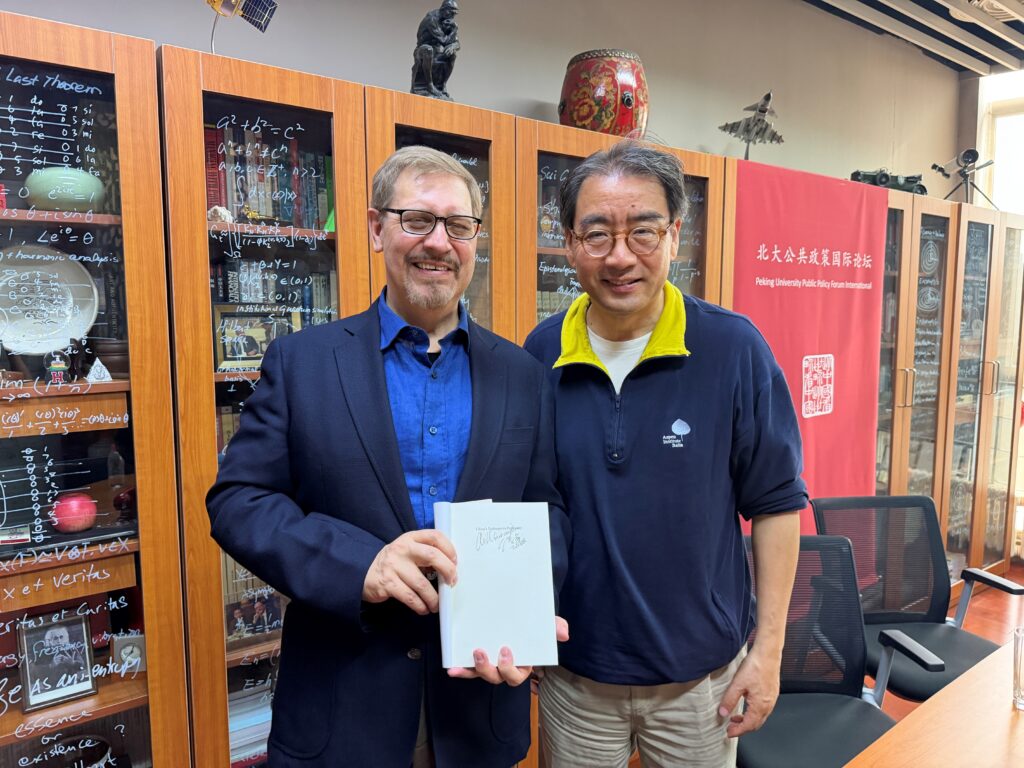
BRIGHT Foundation recently met with Dr. Fu Jun, a renowned scholar and a Harvard-educated powerhouse. He is Academic Dean at Peking University’s prestigious Institute of South-South Cooperation and Development. Dr. Fu is a global authority on political economy. His trans-disciplinary vision shapes international public policy.
BRIGHT met him in his office for a private 3-hour wide-ranging discussion. Topics included complex systems, human learning, artificial intelligence, and the future of brain injury recovery.
A Shared View of Complex Systems
Dr. Fu’s Meta-heuristic Growth Theory models nonlinear, complex systems using dynamic systems theory and thermodynamics. BRIGHT arrived at a very similar conclusion more than 20 years ago. At the time, it attempted to develop a theory of motor development under the influence of brain injury.
BRIGHT wrote: “Stable Attractors are almost always the non-linear, self organizing, optimized solution to the interplay of all factors (neurological, physiological, environmental, etc.)”
Moving Beyond Fragmented Thinking
The conversation brought together Dr. Fu’s work in institutional political economy, mathematical modeling, and systems-level thinking. It was paired with BRIGHT Founder Matt Palaszynski’s long-standing mission. That mission is to advance new approaches for children and families affected by brain injury.
A central theme was the need to move beyond fragmented, discipline-based thinking. Instead, the discussion pointed toward models capable of integrating biology, technology, medicine, family experience, economics, and human motivation.
Brain Injury Recovery as a Complex System
During the meeting, Matt shared BRIGHT’s view on brain injury recovery. It should not be understood only as a medical or movement challenge, but as a complex, dynamic system. He discussed the importance of neuroplasticity, individualized learning loops, and AI-enabled feedback. He also highlighted assistive technologies that can support meaningful functional recovery over time.
The Role of AI and Human Judgment
Dr. Fu emphasized the importance of language, mathematics, and model-building. These help humans understand complex realities. The intense 3-hour discussion also explored how AI may accelerate knowledge discovery. Even so, AI still requires human judgment and deeper theoretical frameworks.
Looking Ahead
Matt Palaszynski, Founder of BRIGHT Foundation, reflected on the meeting:
“Brain injury recovery requires more than isolated interventions. It requires a conductor capable of bringing science, technology, families, and institutions together. Our conversation with Dr. Fu opened an important intellectual pathway for thinking about BRIGHT’s work at a higher systems level.”
BRIGHT looks forward to continuing this dialogue. It will keep exploring how cross-disciplinary thinking can help shape new frameworks for brain injury care, research, and recovery.
About Dr. Jun Fu
Dr. Jun Fu is Lincei Fellow and Professor of Political Economy and Public Policy at Peking University. His research interests include mathematical modeling and institutional political economy. He also studies related policy and legal issues, such as anti-trust and regulations. He is the author of Institutions and Investments and The Dao of the Wealth of Nations.
About BRIGHT Foundation
BRIGHT Foundation is dedicated to advancing support and innovation for individuals and families affected by brain injury. Its work is guided by a Care, Cure, and Community framework. Through this framework, BRIGHT connects lived family experience with research-driven innovation and emerging neurotechnology. It also champions cross-disciplinary collaboration. BRIGHT works to build bridges between families, scientists, clinicians, technologists, and institutions. Together, they help accelerate the path to a “functional cure.”