
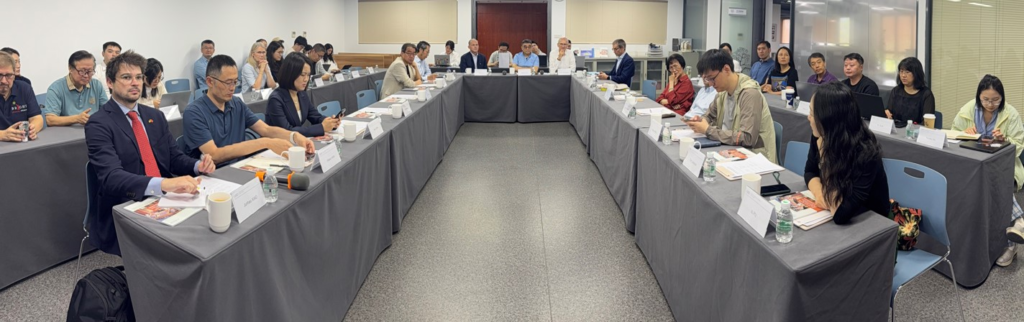
Leadership Dialogue on AI in Health
BRIGHT Foundation Founder Matt Palaszynski recently attended the PKU Global Health Leadership Dialogue. He was also the keynote speaker for PKUIH’s CME event on the future of neuro-rehabilitation and an MOU signer. The event was held by the Peking University Institute for Global Health and Development (PKU-GHD). It brought together experts across neuroscience, public health, data science, artificial intelligence, and global health.
Brain Injury and AI at the PKU Global Health Dialogue
BRIGHT joined the discussion as part of an ongoing effort. It aims to connect brain injury advocacy and research with emerging conversations. These include AI, data infrastructure, and systems-level health innovation.
During the event, Matt had the opportunity to exchange views with speakers. Topics included the importance of trusted data, cross-disciplinary collaboration, and responsible technology development in brain health.
Leading Voices at the Dialogue
Attendees of the event included Dr. Liu Haiguang, Chief Scientist and Director of Research at the Beijing Zhongguancun Academy (ZGCA). They also included Dr. Fu Jun, a renowned scholar and a Harvard-educated powerhouse. Dr. Fu is Academic Dean at Peking University’s prestigious Institute of South-South Cooperation and Development. Dr. Bernhard Schwartländer, Distinguished Chair Professor of Planetary Health at PKU, also attended, among others.
The Pillars of a Global Paradigm Shift
The dialogue brought together the exact pillars needed to scale a global paradigm shift. Dr. Liu Haiguang anchored the cutting edge of tech infrastructure. Dr. Fu Jun brought elite international development and policy insights. Dr. Bernhard Schwartländer tied it to macro global health governance.
For BRIGHT, this wasn’t an exercise in academic theory. It was an operational meeting of the minds to design an ecosystem where AI robotics and neuro-recovery can scale globally. The dialogue also reinforced the importance of building bridges between families, scientists, clinicians, technologists, and institutions.
“Big Science Is Broken”
During the discussions, Matt challenged the status quo directly. He stated that “big science is broken and needs a paradigm shift.” This perspective resonated strongly with Dr. Fu Jun and Dr. Liu Haiguang. They agreed that traditional research frameworks have become locked in a loop of sub-optimization. Billions are spent making marginal, incremental improvements within an outdated system rather than driving true breakthrough innovation.
For BRIGHT, this shared conviction reinforces the urgent need for a new architectural approach to neuro-recovery.
Human-Centered Innovation for Brain Injury
AI continues to transform the future of healthcare. BRIGHT remains committed to ensuring that innovation is directed toward practical, human-centered outcomes. These outcomes must serve individuals and families living with brain injury.
About PKU-GHD
The Peking University Institute for Global Health and Development (PKU-GHD) is a leading interdisciplinary research institute. It is dedicated to advancing global health through policy research, academic collaboration, and capacity building. The institute focuses on key areas such as health systems strengthening, global health governance, and digital health. It also focuses on the intersection of technology and public health.
About BRIGHT Foundation
BRIGHT Foundation is dedicated to advancing support and innovation for individuals and families affected by brain injury. Its work is guided by a Care, Cure, and Community framework. Through this framework, BRIGHT connects lived family experience with research-driven innovation and emerging neurotechnology. It also champions cross-disciplinary collaboration. BRIGHT works to build bridges between families, scientists, clinicians, technologists, and institutions. Together, they help accelerate the path to a “functional cure.”ed family experience with research-driven innovation, emerging neurotechnology, and cross-disciplinary collaboration. BRIGHT works to build bridges between families, scientists, clinicians, technologists, and institutions to help accelerate the path to a “functional cure”.